Explore our resources by research/diagnostic specialty or content type
ALPCO specialists are leveraging their extensive expertise to create a growing collection of resources for your research and testing. Find resources that benefit your work using the handy filters.
Biologics have been commonly prescribed as therapies for inflammatory bowel disease (IBD) since the late 1990s. However, research demonstrates that not all individuals respond to the first biologic taken and many lose response over time1. As a result, there is a great need to explore the immunogenicity of IBD biologics. Studies indicate that measuring drug levels, free anti-drug antibodies, and...
[playlist images="false" artists="false" tracklist="false" ids="4600"]
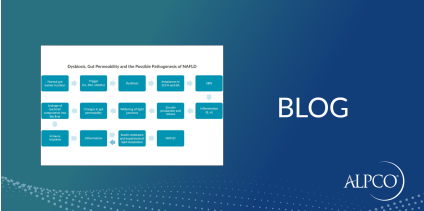
A growing amount of research demonstrates that communication between the gut microbiota and liver is vital for the regulation of energy metabolism1,2. As a result, scientists are further exploring the relationship between the gut microbiota and gut-liver crosstalk to better understand metabolic diseases such as non-alcoho...
We are excited to announce that we will launch new gastrointestinal and inflammatory bowel disease (IBD) assays at Digestive Disease Week® May 7-9, 2017 in Chicago, IL. Included in this release are the Zonulin Stool ELISA and Zonulin Serum ELISA to aid in the study of gut permeability and celiac disease. Both assays specifically quantify levels of zonulin with no cross-reactivity to haptoglobin...
A better understanding of incretins has led to tremendous therapeutic advances in the field of type 2 diabetes1. These hormones are released from the gut in response to food ingestion and lead to the stimulation of pancreatic β-cells which then release insulin in a glucose-concentration dependent manner1. One such hormone is glucagon-like peptide-1 (GLP-1) that has been shown to initi...
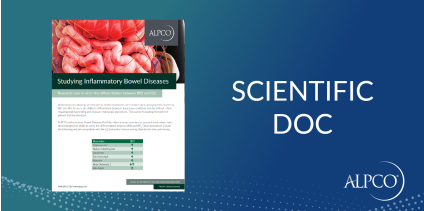
Gastrointestinal (GI) disorders such as inflammatory bowel disease (IBD) and irritable bowel syndrome (IBS), as well as infections from GI pathogens can present very similar symptoms. A host of tests have been developed to aid in the differentiation between IBD and IBS, such as calprotectin and lactoferrin. However, there is still a need for more research to fully understand the process of diff...
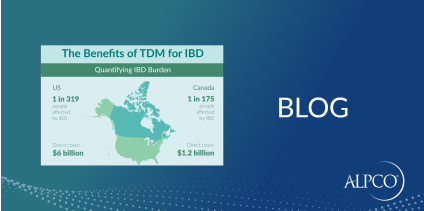
The Burden of Inflammatory Bowel Disease in the US and Canada
More than 1 million people in the US and 200,000 people in Canada are currently living with inflammatory bowel disease (IBD). This number is projected to grow exponentially over the next 10 years1,2. As the prevalence of IBD increases, so do direct healthcare costs. Between hospitalizations, surgery, ambulatory care and biologic the...
Date: June 21, 2016
Author: Andrea Tarbet, Product Marketing Associate at ALPCO
Several therapies exist to help treat inflammatory bowel disease (IBD) and improve patient quality of life. However, a growing number of gastroenterologists and patients have been choosing to stop these therapies - a process known as de-escalation. There is currently no standard of care for de-escalating infla...
What are IBD and IBS?
Inflammatory bowel disease (IBD) and irritable bowel syndrome (IBS) are two different gastrointestinal tract issues affecting millions of people every day. Although there is some overlap between symptoms of IBD and IBS, differences still remain in regards to pathologies, risks of developing related complications, and treatment options. Therefore, it is vital to properly d...
Date: January 26, 2016
ALPCO recently launched a new panel of 13 stool-based gastroenterology assays that are all compatible with one single extraction step. The unique extraction method allows laboratories to improve their sample processing time by up to 86% by extracting one sample for up to 13 biomarkers. In addition, each of these assays is flexible and can be run manually or on automate...
Introduction
We understand the challenges facing lab managers and directors who need to continuously improve workflow efficiency and implement new tests and technologies to be competitive. Our unique extraction method can be used with a portfolio of targeted stool markers. This allows your lab to simplify stool sample processing time by up to 86% by extracting one sample for up to 13 stool-bas...