Explore our resources by research/diagnostic specialty or content type
ALPCO specialists are leveraging their extensive expertise to create a growing collection of resources for your research and testing. Find resources that benefit your work using the handy filters.
Research over the past several decades examining adipokines and adipose tissue-liver crosstalk in energy metabolism has revealed that adipose tissue is a very important metabolically active endocrine organ1. White, brown, and beige adipose tissue generate and secrete adipokines, such as adiponectin and leptin, which facilitate adipose tissue-liver crosstalk and insulin sensitivity1.
https://...
We are excited to announce that we will launch new gastrointestinal and inflammatory bowel disease (IBD) assays at Digestive Disease Week® May 7-9, 2017 in Chicago, IL. Included in this release are the Zonulin Stool ELISA and Zonulin Serum ELISA to aid in the study of gut permeability and celiac disease. Both assays specifically quantify levels of zonulin with no cross-reactivity to haptoglobin...
Date: March 7, 2017
Lately, nonalcoholic fatty liver disease (NAFLD) and nonalcoholic steatohepatitis (NASH) have been widely discussed in both the clinical and research communities. Some of the focus has been related to alternative research methods that can improve diagnostic and monitoring methodologies at the clinical level. These include more sophisticated imaging techniques as well as n...
Nonalcoholic fatty liver disease (NAFLD) is becoming the most common chronic liver disease in the western hemisphere affecting 1 in 3 adults and 1 in 10 children1. Today, liver biopsies are the only gold standard for precise diagnosis of NAFLD2. Because of this, there are tremendous efforts on the research and clinical side to introduce newer, less invasive methodologies which will aid in diag...
A better understanding of incretins has led to tremendous therapeutic advances in the field of type 2 diabetes1. These hormones are released from the gut in response to food ingestion and lead to the stimulation of pancreatic β-cells which then release insulin in a glucose-concentration dependent manner1. One such hormone is glucagon-like peptide-1 (GLP-1) that has been shown to initi...
Gastrointestinal (GI) disorders such as inflammatory bowel disease (IBD) and irritable bowel syndrome (IBS), as well as infections from GI pathogens can present very similar symptoms. A host of tests have been developed to aid in the differentiation between IBD and IBS, such as calprotectin and lactoferrin. However, there is still a need for more research to fully understand the process of diff...
Introduction
Humans and the environment are exposed to numerous chemicals every day1. Each year, about 2,000 new chemicals are manufactured in the U.S.2. Research findings over the years have shown how some chemicals known as endocrine disrupting chemicals (EDCs) can interact with the endocrine system, disrupt homeostasis, and lead to issues such as obesity and sterility1. As a result, endocri...
Date: September 27, 2016
Author: Andrea Tarbet, Product Marketing Associate at ALPCO
From cosmetics to water bottles, endocrine disrupting chemicals (EDCs) have surfaced in our everyday lives. EDCs are compounds that can interfere with the endocrine system’s ability to help an organism develop, grow, reproduce, and maintain overall homeostasis1. Since EDCs are found nearly everywhere, we...
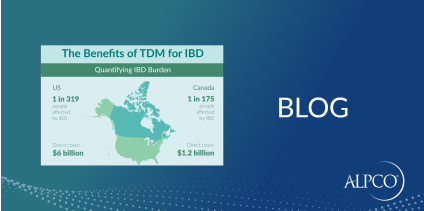
The Burden of Inflammatory Bowel Disease in the US and Canada
More than 1 million people in the US and 200,000 people in Canada are currently living with inflammatory bowel disease (IBD). This number is projected to grow exponentially over the next 10 years1,2. As the prevalence of IBD increases, so do direct healthcare costs. Between hospitalizations, surgery, ambulatory care and biologic the...
Date: September 6, 2016
Author: Andrea Tarbet, Product Marketing Associate at ALPCO
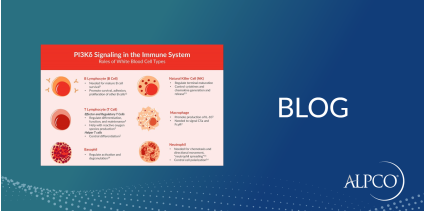
Signaling pathways dictate the differentiation, activation, and functions of immune cells. Even the slightest problem in one cell signaling pathway can transform the immune system and turn it against the body, causing an autoimmune disease. Research has shown that proper phosphoinositide 3-kinase (PI3K) c...